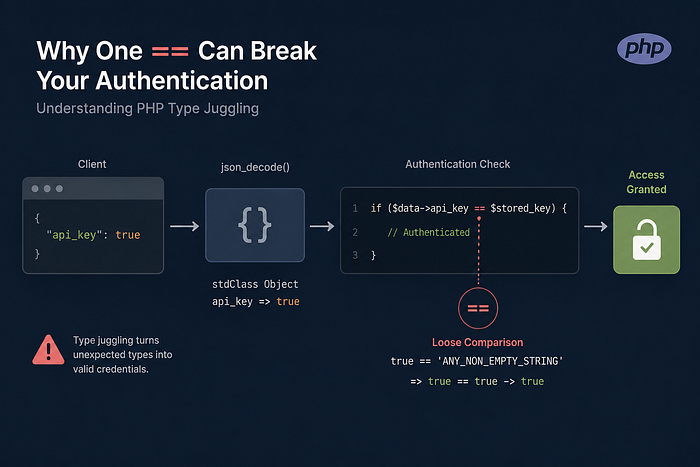
“Security vulnerabilities are often portrayed as sophisticated memory corruptions or cryptographic failures. In reality, some of the most impactful bugs originate from a single character.”
During a recent security audit of a WordPress plugin, I discovered an authentication flaw that wasn’t caused by SQL injection, command execution, or weak cryptography. Instead, the root cause was something much simpler:
if ($provided_api_key == $stored_api_key) {
    // authenticated
}
One loose comparison operator (==) was enough to undermine the authentication logic.
Although the specific vulnerability has since been responsibly disclosed and patched, what interested me most wasn’t the bug itself — it was why it happened. The issue highlights a class of vulnerabilities that every PHP developer and security researcher should understand: Type Juggling.
In this article, we’ll explore how PHP’s automatic type conversion works, why it becomes dangerous in security-sensitive code, and what developers can do to avoid introducing similar vulnerabilities.
What Is Type Juggling?
PHP is a dynamically typed language.
Unlike statically typed languages, variables in PHP don’t have fixed types, and the language will often convert values automatically when evaluating expressions.
Consider the following examples:
var_dump(5 == "5");          // true
var_dump(false == 0);        // true
var_dump(true == 1);         // true
var_dump("10" == 10);        // true
These results surprise many developers coming from languages such as Java, Go, or Rust.
PHP tries to determine a “common” type before comparing two values. This behavior is called type juggling (or implicit type conversion).
Most of the time, this makes development more convenient.
Sometimes, however, convenience and security do not coexist.
Loose Comparison vs Strict Comparison
PHP provides two comparison operators:
==and
===Although they appear similar, they behave very differently.
Loose comparison
5 == "5"Result:
truePHP converts the string into an integer before comparing.
Strict comparison
5 === "5"Result:
falseBoth value and type must match.
This distinction becomes critical whenever secrets, passwords, API keys, authentication tokens, or cryptographic material are involved.
Why Authentication Logic Is Different
Authentication answers one question:
“Does this user possess the exact secret that I generated?”
Notice the word exact.
There is no room for “close enough.”
Unfortunately, using loose comparison asks PHP to decide whether two values are “equivalent” rather than identical.
That’s rarely what we want when validating secrets.
A Real-World Code Review
While reviewing the plugin’s source code, I eventually reached the API authentication routine.
The logic was straightforward.
The application loaded the stored API key from the database and compared it with the value supplied by the client.
Conceptually, it looked like this:
$storedKey = get_api_key();

if ($clientKey == $storedKey) {
    // allow request
}
Nothing looked obviously wrong.
The comparison appears reasonable at first glance.
But one detail immediately stood out:
The code used == instead of === or a dedicated comparison function.
Whenever I encounter loose comparisons inside authentication code, it becomes a signal to investigate further.
Not because they’re always vulnerable — but because authentication and implicit type conversion are an inherently risky combination.
The Missing Piece: JSON
The next part of the puzzle wasn’t the comparison itself.
It was how the input arrived.
The endpoint accepted JSON requests.
When PHP parses JSON, it preserves native data types.
For example:
{
    "enabled": true,
    "count": 5,
    "name": "Alice"
}
becomes
$data->enabled // boolean
$data->count   // integer
$data->name    // string
This is an important distinction.
Developers often assume that user input is always text.
That assumption is generally true for HTML forms.
It is not true for JSON APIs.
A JSON parser can produce booleans, integers, floating-point numbers, arrays, objects, and null values directly.
If authentication code assumes every input is a string, unexpected behavior may occur.
The Real Root Cause
The vulnerability wasn’t simply “using JSON.”
It wasn’t simply “using PHP.”
It wasn’t even simply “using ==.”
It was the combination of three design choices:
- Accepting structured JSON input.
- Performing no explicit type validation.
- Using loose comparison during authentication.
Each decision appears harmless on its own.
Together, they created an authentication weakness.
This is an important lesson in secure software engineering:
Many vulnerabilities are not caused by one catastrophic mistake — they emerge from several individually reasonable decisions interacting in unexpected ways.
Why This Class of Bugs Is Dangerous
Type juggling vulnerabilities have appeared repeatedly throughout PHP’s history.
Authentication systems are particularly attractive targets because they compare secrets.
Common examples include:
- Password validation
- API key verification
- Session tokens
- Password reset tokens
- HMAC validation
- CSRF tokens
Whenever sensitive values are compared using loose comparison, developers should pause and ask:
“Should PHP really be deciding how these values are converted?”
In almost every authentication scenario, the answer is no.
Defensive Programming
Fortunately, avoiding this entire class of vulnerabilities is straightforward.
1. Use strict comparison
Instead of:
if ($provided == $stored)prefer:
if ($provided === $stored)This prevents implicit type conversion.
2. Validate input types
If an API expects a string, verify that assumption explicitly before performing any security-sensitive operations.
Failing early makes the code easier to reason about and reduces unexpected behavior.
3. Use hash_equals() for secrets
When comparing API keys, authentication tokens, or cryptographic values, PHP provides a dedicated function:
hash_equals($stored, $provided);Besides requiring identical strings, it also performs a constant-time comparison, helping reduce timing side-channel attacks.
4. Treat JSON as Typed Data
This is perhaps the biggest lesson I took away from this research.
JSON is not simply another way of sending text.
It carries type information.
Applications that deserialize JSON should consciously validate those types before making authorization or authentication decisions.
Lessons Learned
One thing I enjoy about vulnerability research is that the most valuable takeaway isn’t always the vulnerability itself.
It’s understanding why the vulnerability existed.
This audit reinforced several lessons for me:
- Small implementation details can have security implications.
- Dynamic languages require careful handling of implicit conversions.
- Authentication code deserves stricter standards than ordinary business logic.
- Secure coding is often about removing ambiguity rather than adding complexity.
Perhaps most importantly:
A single character can completely change the security properties of a system.
Replacing
==with
===or, even better,
hash_equals()may appear insignificant during code review.
Sometimes, it’s the difference between a secure authentication mechanism and one that silently accepts unexpected input.
Final Thoughts
As security researchers, it’s easy to focus on impact, CVSS scores, or proof-of-concept demonstrations.
Those are certainly important.
But the vulnerabilities that leave the strongest impression are often the This research reminded me that security isn’t always about sophisticated exploitation techniques.
Sometimes, it’s about understanding the programming language just a little better than the person who wrote the code.
If this article encourages even one developer to replace a loose comparison in authentication code — or one security researcher to look twice at an innocent-looking ==—then it has served its purpose.
Thanks for reading! If you enjoy articles about vulnerability research, secure coding, and offensive security, feel free to follow me on Medium for future write-ups exploring the reasoning behind real-world security findings.